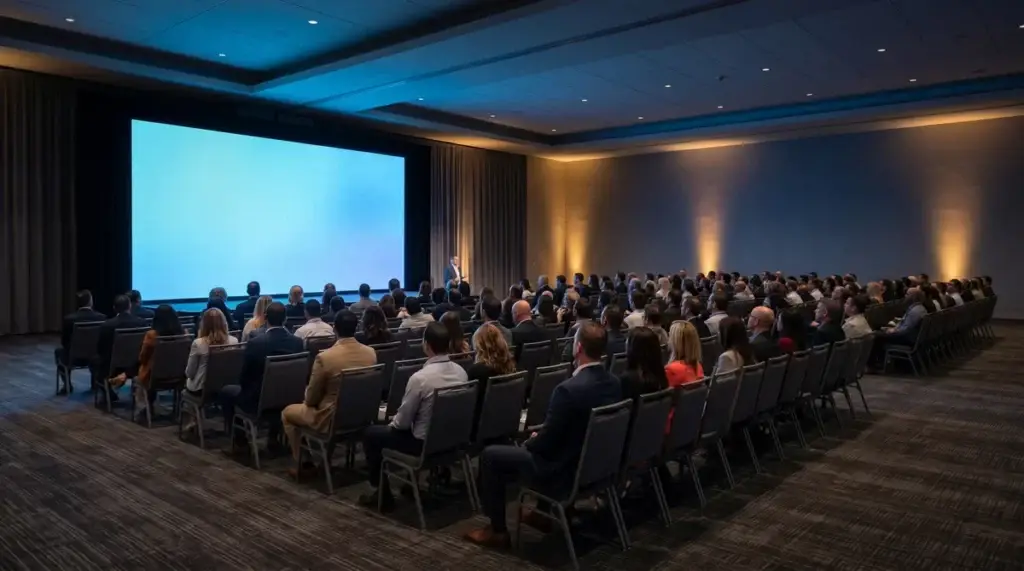
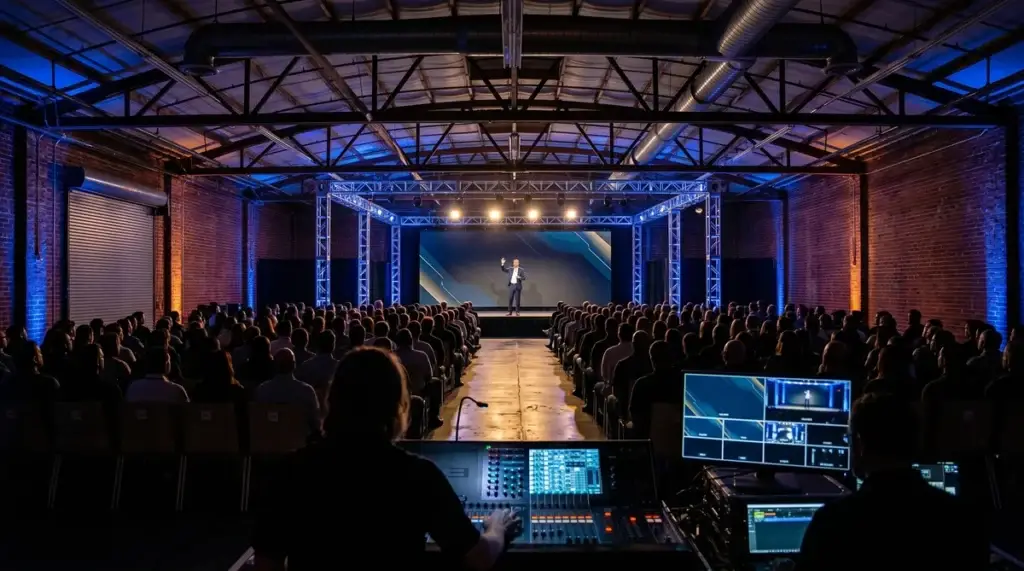
The gap between two production quotes for the same 250-person corporate event usually isn’t the gear. The cheap quote and the premium quote often list the same line array, the same LED wall, similar lighting fixtures, similar staging. What separates them is what you can’t see on the quote: 5 hours of pre-production behind the cheap version, 30 hours behind the premium one. Same equipment, completely different show. That gap is what an event production company actually does, and it’s the part most planners don’t know they’re buying.
A production company designs, builds, and operates the technical and creative spine of a live event. It isn’t a planner. It isn’t a rental house. It’s the team responsible for what happens on the stage, through the speakers, on the screens, and behind the scenes from load-in through strike. This is what’s actually inside that work, how it differs from rental and planning, and when it pays for itself.
What you’re actually buying
A production company owns the technical and creative execution of your event. They turn a run-of-show document into sound, lights, video, and a stage the audience experiences. They work alongside the planner, the venue, and the caterer, not instead of them. Their work starts weeks before doors and doesn’t end until the last cable is coiled.
Three things define a real production company:
- Integrated team. One group handles planning, design, build, show crew, and strike. Not five vendors coordinating through text messages on show day.
- Owned inventory. A warehouse of gear they know works. Not sub-renting the basics every time.
- Documented process. CAD drawings, power plots, show files, cue sheets, named backup plans. Production companies execute a plan they wrote.
Miss any of those three, you’re hiring something else wearing the label.
Why production, planner, and rental house aren’t interchangeable
These three roles get conflated constantly, and planners pay for the confusion.
Event planner. Owns the event concept, the guest experience, the timeline, the budget, the venue relationship, catering, registration, branding, and stakeholder communication. Think of the planner as the general contractor for the event.
Production company. Owns the technical build and operation: audio, video, lighting, LED walls, staging, rigging, show crew, and the production timeline. Think of the production company as the technical contractor.
Rental house. Owns gear in a warehouse and rents it out by the day. Doesn’t plan, design, or run the show. You’re buying equipment, not production.
A 500-person corporate event usually involves all three: a planner running the overall show, a production company handling the technical build, and sometimes a specialty rental house for one piece of gear the production company doesn’t own (a rare camera body, a specific LED product, a niche specialty fixture). A 50-person internal meeting can collapse the roles down to a rental drop-off and a planner who manages the AV box. A 5,000-person multi-track conference uses all three and adds a dedicated production manager on top.

The seven things you’re paying for, and the two you actually see
When you hire a production company, you’re paying for seven categories of work. Most planners only see two of them on show day.
1. Discovery and design
Before anything gets built, the production team has to understand the event goals, the audience, the brand, the venue, and the timeline. A real discovery includes:
- A creative brief from the client
- A venue walkthrough or full site survey
- Audience sightline analysis
- Brand and visual direction review
- Technical goals (livestream, recording, broadcast)
- Integration points with the planner and other vendors
Output: a production concept document with proposed stage design, technical scope, and a working budget range. If the first thing a vendor sends you is a quote, they skipped this step.
2. The pre-pro nobody sees
This is the invisible work that decides whether show day goes smoothly. A production company running a real pre-production cycle invests 10 to 40 hours of planning before anyone touches gear. Premium production typically runs 20 to 40 hours of pre-pro for a mid-size event. Commodity production runs 3 to 5 hours and improvises the rest.
Typical pre-production deliverables:
- CAD drawings of the stage layout to scale
- Power and signal plots
- Rigging plot with load calculations
- Lighting design with a programmed show file
- Video routing and switcher file
- Audio plot (mic plot, monitor mixes, inputs and outputs)
- Production schedule, minute by minute, load-in through strike
- Crew roster with named roles and named backups
- Vendor coordination (planner, venue, catering, specialty rentals)
Without pre-production, show day becomes improvisation. Improvisation costs time, money, and usually the client’s patience.
3. Build and load-in
Load-in is when the gear shows up and the production gets built. A 300-person corporate event load-in typically takes 6 to 10 hours. A 2,000-person multi-track conference takes 24 to 48 hours, sometimes longer if the venue is complicated.
What happens during load-in:
- Truck unload and case staging
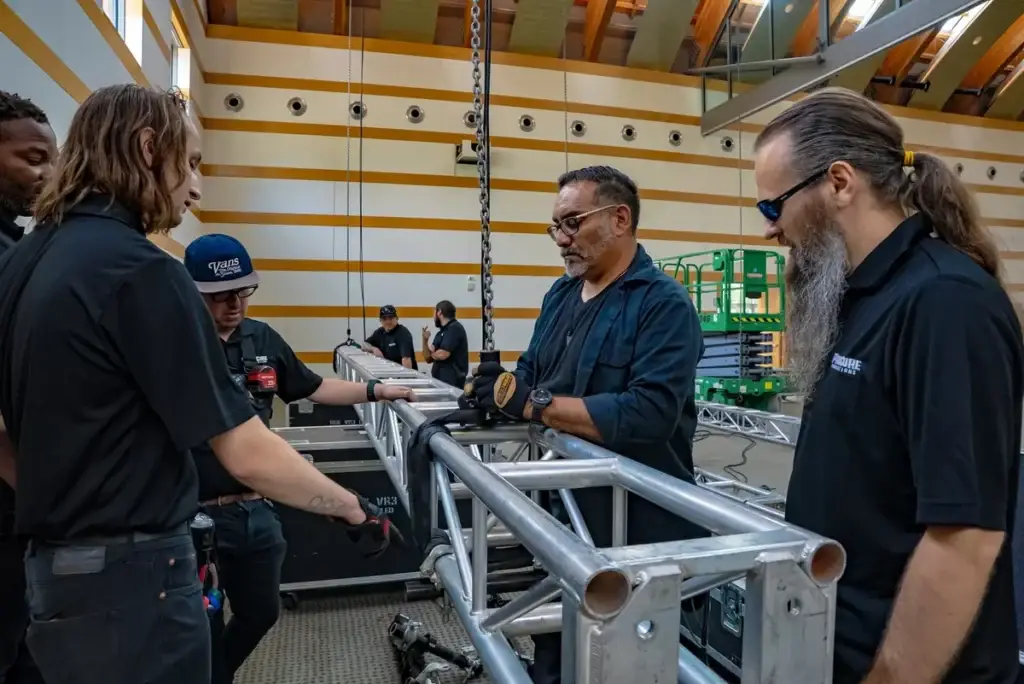
- Rigging: trusses, motors, line array hangs, lighting positions
- Power distribution: production distros, cable runs, UPS on critical circuits
- Staging: deck, stairs, ADA ramps, pipe and drape
- LED walls: panel build, processor setup, content QC
- Audio: PA fly, monitors, console patch, wireless frequency coordination
- Lighting: fixture focus, color or gobo loading, console programming
- Video: camera setup, switcher build, routing, IMAG checks
The production company runs all of this against the venue’s facilities team, union labor if required, and the planner’s overall timeline.
4. Rehearsal and tech check
Most events that need a rehearsal don’t get one because nobody budgeted the time. A real rehearsal includes:
- Full audio soundcheck with the actual presenters
- Video cues with real content playback
- Lighting look programming and review
- Camera blocking for IMAG or broadcast
- A full run-through with the planner and MC
Tech rehearsal is typically the day before the show. Tech check (morning of) confirms every piece of gear is live. For a product launch, broadcast gala, or major announcement, both are non-negotiable. For a simple internal meeting, the morning tech check alone can carry the day.
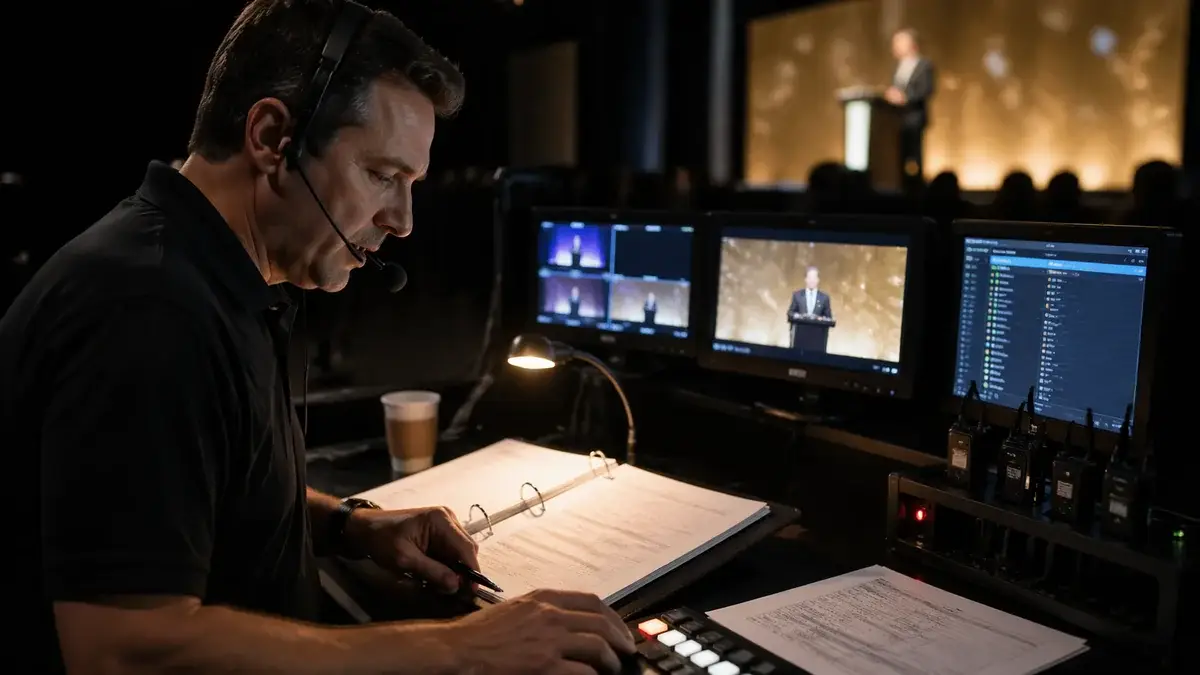
5. Show day, when production is supposed to be invisible
The production company runs the show. That means:
- Dedicated roles at each console (audio at FOH, video at the switcher, lighting at the lighting console)
- A show caller running cues over comms
- Stage management coordinating with talent
- Floor leads handling crew and any in-show issues
- Documentation of anything that goes sideways, in real time
The good production companies have show documentation that survives the event: cue sheets, post-show notes, what went wrong and what got adjusted. That feeds the next show with the same client.
6. Strike and load-out
Strike is the reverse of load-in, and it almost always happens under time pressure because the venue wants the room back. Strike of a mid-size event runs 3 to 6 hours. A large corporate event runs 8 to 14 hours.
A sloppy strike damages gear, tears carpet, blows past the venue’s exit window, and leaves the planner with problems they didn’t sign up for. A good strike returns the venue cleaner than load-in.
7. Post-event debrief
The piece most companies skip. A real debrief includes:
- What worked
- What didn’t
- Gear issues to fix before the next show
- Client feedback captured while it’s fresh
- Invoice reconciliation against what was actually used
Production companies that skip debriefs repeat their mistakes. The ones that run them get incrementally better with every event. Over a year, the gap between debriefing and not debriefing is the gap between commodity and premium.
When a rental house is enough, and when it isn’t
Not every event needs a production company. The honest decision framework:
A production company is the right call when:
- The event has multiple presenters, multiple rooms, or a livestream
- LED walls, flown audio, or significant lighting are involved
- The venue requires outside labor coordination
- The event is brand-critical (a failure would embarrass the company internally or externally)
- Multiple disciplines (audio + video + lighting) need to be coordinated to a single timeline
- You need integrated planning, not just gear
A rental house works when:
- The event is under 150 people with a simple format
- Setup is one mic, one screen, one room
- The venue’s house sound and lighting are usable
- Nothing is broadcast, recorded, or streamed
- You have someone on your team who can coordinate AV on the day
A planner alone is enough when:
- The event is non-technical (cocktail reception, networking mixer)
- AV needs are minimal, maybe a microphone
- The venue’s house AV is adequate
The 150-person headcount is a useful rule of thumb but the real driver is complexity. A 120-person product launch with a livestream and a custom set is production work. A 300-person internal town hall with one mic and a projection screen is rental work. Headcount matters, but multi-discipline complexity matters more.
Related reading: hiring a production company vs renting gear: when each makes sense.
What an LA production budget actually looks like
Production cost scales with event size, venue complexity, and creative ambition. LA-market ranges, including crew, gear, planning, transport, and power (not venue rental, catering, or marketing):
| Event Profile | Typical Production Budget |
|---|---|
| Small corporate meeting (50-100 pax) | $4,000 – $10,000 |
| Mid-size conference (150-300 pax, full day) | $15,000 – $45,000 |
| Large corporate event (500+ pax, multi-day) | $60,000 – $250,000+ |
| Gala with full AV build and broadcast | $50,000 – $250,000 |
| Multi-day summit or product launch | $100,000 – $500,000+ |
| Experiential brand activation | $40,000 – $350,000+ |
The small-meeting floor at $4,000 includes crew, setup, and on-site operation. Below that, you’re in box-drop rental territory, not production.
The spread within each bracket is driven by three things: LED wall specs and size, livestream and broadcast quality tier, and the ambition of the creative design. A production company should walk you through what you’re getting at each price point before you commit, not after.
Full breakdown: what percentage of your event budget should go to AV.
Same gear, different process: premium vs commodity
The difference between a commodity production company and a premium one isn’t usually the inventory. Most serious production companies in LA have similar gear. The difference is the process.
Premium production delivers:
- Pre-production investment. 20 to 40 hours of planning before load-in for a mid-size event. Commodity does 3 to 5 hours and wings the rest.
- Same crew from planning through show. The person who designed it is the person running it. Commodity hands off between teams and loses context every handoff.
- Documented backup plans. Real contingency gear, named roles if the lead calls out, backup wireless frequencies, spare packs in a labeled case. Commodity hopes nothing goes wrong.
- Creative partnership. A production designer who pushes on the creative direction, not just a tech who executes whatever the planner hands over. Commodity has no opinion on the show’s design.
- Post-event documentation. Real debriefs, notes for next time, relationship continuity. Commodity moves on to the next gig without looking back.
If you’re spending more than $25,000 on production, you’re already in the premium price range. If the company you’re talking to can’t show you the differences above, you’re paying premium dollars for commodity work.
Four questions that separate real production from rental in a polo
Send these to anyone giving you a production quote. The answers tell you who you’re hiring.
1. Walk me through your production process. A real answer names the phases (discovery, design, pre-production, build, show, strike, debrief) with rough hour estimates for each. Vague answers mean vague process.
2. Can I have references from similar events? Names and phone numbers of planners who ran events comparable in size and complexity. Not testimonials on a website. Call them.
3. Who specifically will run my show? Named individuals at the quote stage, not “we’ll assign a crew closer to the date.” Show quality lives or dies on show crew. If they can’t tell you who, that’s the answer.
4. What’s your contingency plan? Specific. Named backup gear, named backup frequencies, named secondary crew. “We’re reliable” isn’t a plan. “If our lead audio engineer calls out, our second is X, and our backup wireless rack is Y” is a plan.
Deeper checklist: 7 questions to ask your AV company before you sign.
Frequently Asked Questions
What’s the difference between an event production company and an event planner?
A production company owns the technical and creative execution: audio, video, lighting, staging, crew. A planner owns the broader event concept: venue, catering, guest experience, timeline, branding. They work together on larger events. On smaller events, one or both roles can collapse.
Do I need an event production company for a 100-person meeting?
Usually not. A 100-person corporate meeting typically needs a PA system, a microphone, and maybe a projector. That’s a rental-house job. Production companies become worth the cost above 150 to 200 people, when audio, video, and lighting all need to coordinate to a single timeline.
Is event production the same as AV rental?
No. AV rental is equipment by the day. Event production is the equipment plus the planning, the crew, the design direction, and the project management.
How far in advance should I hire an event production company?
Standard corporate event: 6 to 12 weeks is comfortable. Gala or broadcast-grade show: 12 to 24 weeks. Major product launch or experiential activation: 6 to 12 months. The more creative the show, the more pre-production time matters.
What does the cheapest event production look like?
Around $4,000 to $6,000 for a small corporate meeting with basic AV and a minimal crew. Below that, you’re not hiring production, you’re renting gear.
Does an event production company handle creative content (video, slides, branding)?
About half do, half don’t. Many focus on technical execution and leave creative content to the client or a separate creative agency. Confirm before signing. If creative content is part of your scope, get it in writing who’s producing it.
Can I use a production company for a virtual or hybrid event?
Yes. Virtual and hybrid events are core work for most production companies now. For virtual specifically, ask about broadcast infrastructure, streaming platforms, and the engagement tools they support. Some companies are still primarily in-person and will sub-contract the streaming, which adds coordination overhead.
What’s the strongest signal a production company is right for my event?
They ask the right questions before quoting. A vendor who quotes equipment-only without asking about your goals, audience, venue, and timeline is a rental house wearing a production label.
The takeaway
An event production company turns your event vision into something the audience experiences: the sound in the room, the image on the screen, the light on the presenter, the stage they’re standing on. Done well, it’s invisible. Done badly, it’s the thing everybody remembers.
In the LA market, the gap between commodity production and premium production is wider than most planners realize. The gear looks similar on a website. The process is completely different.
If you’re planning a corporate event, gala, conference, or product launch in Los Angeles and you want to understand what real production looks like for your specific show, get in touch. We’ll walk you through our production process before we quote it.