Every projector rental conversation in Los Angeles eventually turns into a ceiling-height conversation. The planner wants a 16-foot screen. The venue is a junior ballroom at a flagship downtown hotel with a 10-foot ceiling. The math, regardless of budget, says no. That gap, between what people want a projector to do and what a room will physically allow, is where most LA projector rental quotes go sideways before lumens, throw distance, or laser-versus-lamp even enter the conversation.
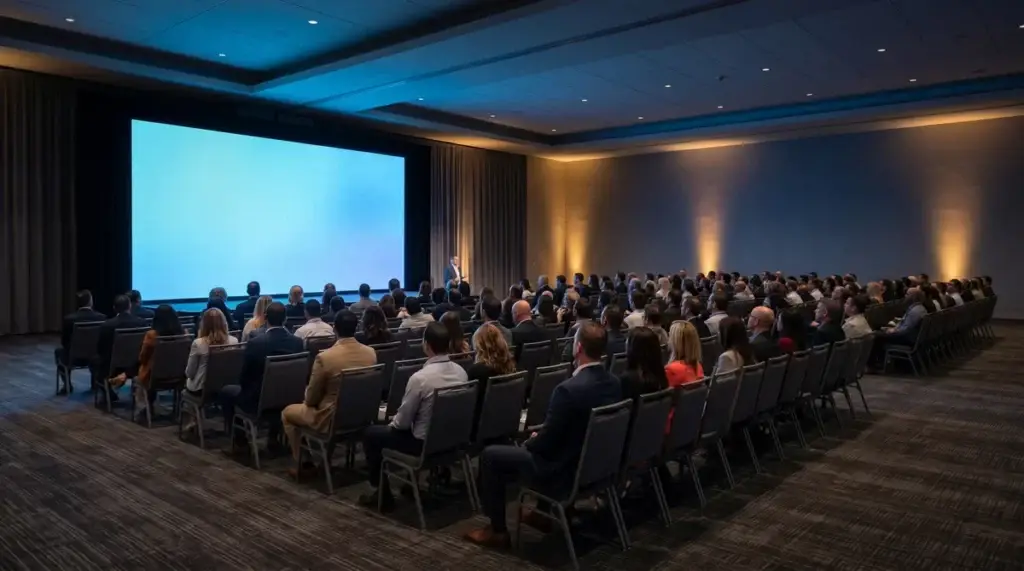
LA has a wide spread of corporate event rooms. The Westin Bonaventure’s California Ballroom runs 18 feet ceiling-to-floor across 26,108 square feet. Two floors up, the Catalina room is 10.1 feet across 8,190 square feet (per The Vendry’s published venue specs). The JW Marriott LA LIVE Diamond Ballroom is 25 feet. Most planner pain isn’t in the flagship spaces. It’s in the breakouts, junior ballrooms, and second-tier rooms that come in at 10 to 12 feet, where a screen on legs, with safe headroom for talent, caps out around 7 to 8 feet tall before sightlines collapse for anyone past row five.
Pick the screen size from the room, then back into the projector. Not the other way around.
The lumens question, and why it’s actually a light question
The number planners get asked for first is “how bright a projector do we need.” That number is almost always the wrong place to start. Brightness is a derived value. The variables that drive it are screen size and ambient light, and ambient light is the one planners control.
AVIXA’s published guidance for a projector matching an LCD display in a typically lit room is about 100 lumens per square foot of screen. A 16-by-9 screen with a 120-inch diagonal is roughly 41 square feet. A 4,000-lumen projector on that screen puts you at about 98 foot-lamberts. That’s borderline acceptable in a room with house lights at half. It is not acceptable with the lights at full or a window open behind the audience.
Doubling the screen size doubles the lumens you need. A 200-inch screen is roughly 110 square feet. The same 4,000-lumen projector on that screen drops to 36 foot-lamberts, which looks washed-out and tired even in a dim room. That math is where 7,500, 12,000, and 20,000-lumen projectors enter the conversation, not because the planner wanted brighter, but because the screen got bigger.
The other half of the equation is light level. A working production company asks for the light plot before pricing a projector. If house lights are coming down to 20 percent for the keynote, a 7,500-lumen unit handles a 200-inch screen. If house lights stay at 60 percent for the awards segment, you need 12,000 or more, or you need to talk about LED instead. Quotes that recommend a projector without asking what the room is doing are quotes that haven’t actually done the math.
Daylight is a problem projectors don’t solve
Outdoor and daylight-adjacent corporate events generate the most expensive projector rental mistakes in LA. The reason is physics, not budget. A sunny LA afternoon puts somewhere between 6,000 and 10,000 lumens of ambient light onto every square foot of any surface a projector is trying to compete with (per Blair Neal’s daylight projection breakdown). No rentable projector outruns that. The image is gone before it leaves the lens.
The honest answer for any outdoor daytime event in LA is one of three things: shade the screen with a structure, move to LED tiles (which start at 5,000 nits and don’t care about the sun), or wait until sunset. Pretending a 30,000-lumen projector will do it on a Palisades patio at 2pm is how planners end up apologizing to a CEO. We have, more than once, talked a client out of a daylight projection rental and into LED with the same budget. The image looked better. The crew slept easier.
Laser is the default in 2026, but lamp still has a job
Two light sources show up in LA projector rental quotes: laser and UHP lamp. The defaults have flipped over the last three years. Laser is now the rental standard for any event that runs more than one show day or projects at any duration that matters.
A laser projector like the Epson Pro L20000UNL is rated for 20,000 hours of light source life in normal mode and 30,000 in extended. That’s not the failure point. That’s the point at which the laser drops to 50 percent of original brightness. A laser projector on a corporate rental fleet, even one running every other weekend, is going to deliver a decade of consistent brightness before anyone needs to talk about a service event.
Lamp projectors are rated 2,000 to 4,000 hours, and that number is also the 50-percent point, not failure (per ProLampSales’ rated life explainer). The practical implication is that a lamp projector loses meaningful brightness well before it fails. On a multi-day event, a unit that started at 7,500 lumens on Tuesday might be putting up 5,500 by Friday and the planner is wondering why the screen got dim. The lamp is doing exactly what it was rated to do. It’s just doing it in front of an audience.
Lamp still wins on upfront cost. A 7,500-lumen lamp projector rents for less than a comparable laser unit. For a single show day in a dark room, the cost difference is real and the brightness drop is invisible. That’s the case to keep lamp on the table. For everything else, laser is the answer.

The screen size question (and the 4/6/8 rule)
Screen size is governed by the AVIXA DISCAS standard, ANSI/INFOCOMM V202.01, which most planners will never read. The simplified field version is the 4/6/8 rule: the farthest viewer in the room should be no more than four times the image height for analytical content (spreadsheets, fine type), six times for general presentation (slides with normal type sizes), and eight times for passive viewing (video, talking-head content).
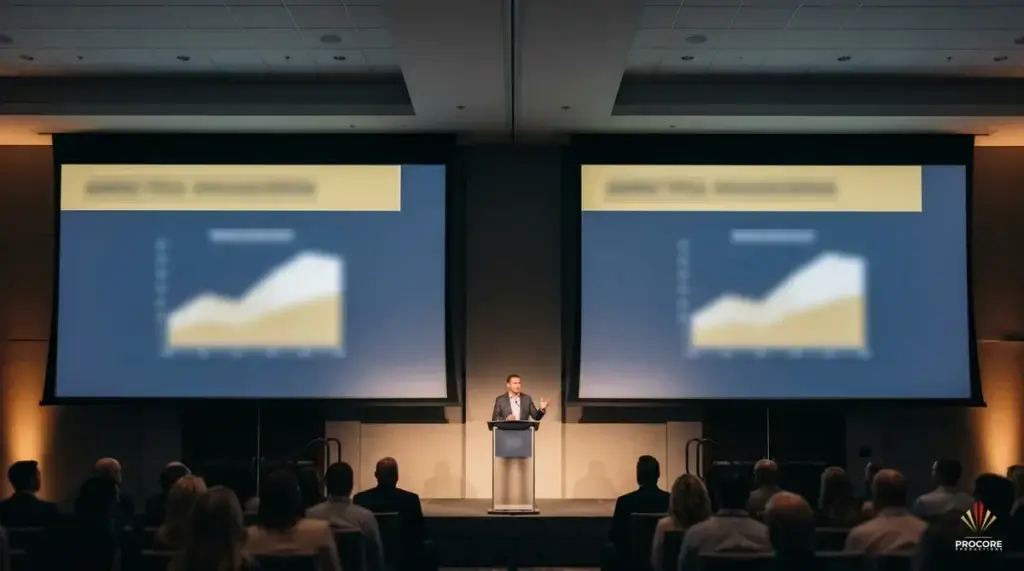
The math in practice: if the farthest row in a 60-foot-deep ballroom is 50 feet from the screen, the screen height needs to be at least 8.3 feet for general presentation content. That’s a screen with a 16-by-9 aspect ratio that’s roughly 15 feet wide. That screen needs about 10 to 11 feet of ceiling once you account for screen frame, dress kit, and floor-to-bottom-of-screen for sightlines. In a 10-foot room, you can’t have it. The conversation has to shift to dual screens at smaller size, monitors on the sides, or a moved-up audience.
The trap is selecting screen size by intuition. “We have 300 people, let’s go big” produces a 20-foot screen that doesn’t fit, costs three times what was needed, or competes with a low ceiling and makes the room feel claustrophobic. Determine your screen size from the audience layout outward. The headcount is downstream.
Front projection, rear projection, or LED
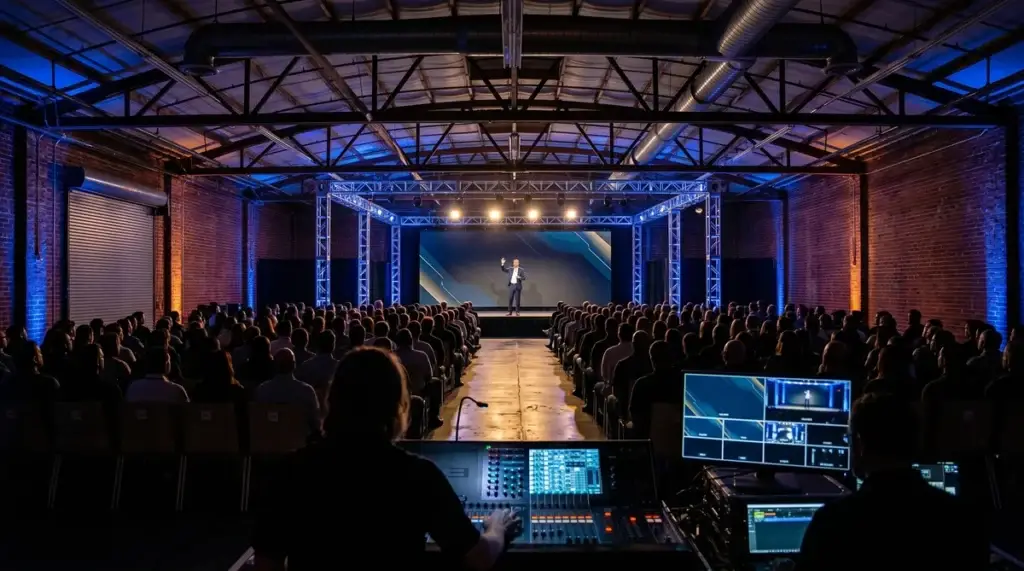
Most LA corporate events use front projection. The projector hangs from truss or sits on a tower at the back of the room, throws the image forward onto a screen. It’s cost-effective, lower crew, and the gear travels well. The downside is the projector beam crosses the audience, which means if anyone walks in front of it during the show (a panicked AV tech, a wandering bride, the GM in a hurry), their shadow shows up on the screen.
Rear projection puts the projector behind the screen. The image is brighter at any given lumen rating because there’s no audience throw distance to lose light over, and nobody can cast a shadow. The footprint depends entirely on the lens, not a fixed multiple of screen width. Most modern professional projectors (Epson, Christie, Panasonic, Barco) ship with interchangeable lenses, and a short-throw lens can hit a 16-by-9 foot screen with as little as 10 feet of throw distance between lens and screen. A standard lens on the same screen wants 18 to 25 feet. The two setups are the same projector, the same screen, the same image — different lenses. The lens call is the one that decides whether rear projection fits the room.
LED is the third option, and the right one for ambient-light rooms or anywhere blackout isn’t possible. LED tiles are self-illuminating, so they don’t care about house lights, windows, or the floor-to-ceiling glass on the west wall of the Beverly Hilton. The tradeoff is cost (LED runs roughly 3 to 5 times what an equivalent projector setup runs) and crew (LED needs more setup hours and a processor operator). The decision tree, per Creative Day Technologies’ comparison, comes down to whether the room can go dark. If it can, projection holds. If it can’t, you’re talking LED.
A working production company quotes the option that fits the room. A company quoting projection for a daylight rooftop event is going to ruin your event.
What an LA projector rental quote should include
A clean projector rental quote in LA typically looks like this:
- Projector model, lumens, and light source type. Not “high-output projector.” A model number, ANSI lumen rating, and laser-or-lamp call.
- Screen size, type, and frame. Front or rear, fast-fold versus dress kit, 16:9 or other aspect ratio, with dimensions.
- Lens. Throw distance is a function of lens, not projector body. Specify short-throw, standard, or zoom and the calculated throw distance for the room.
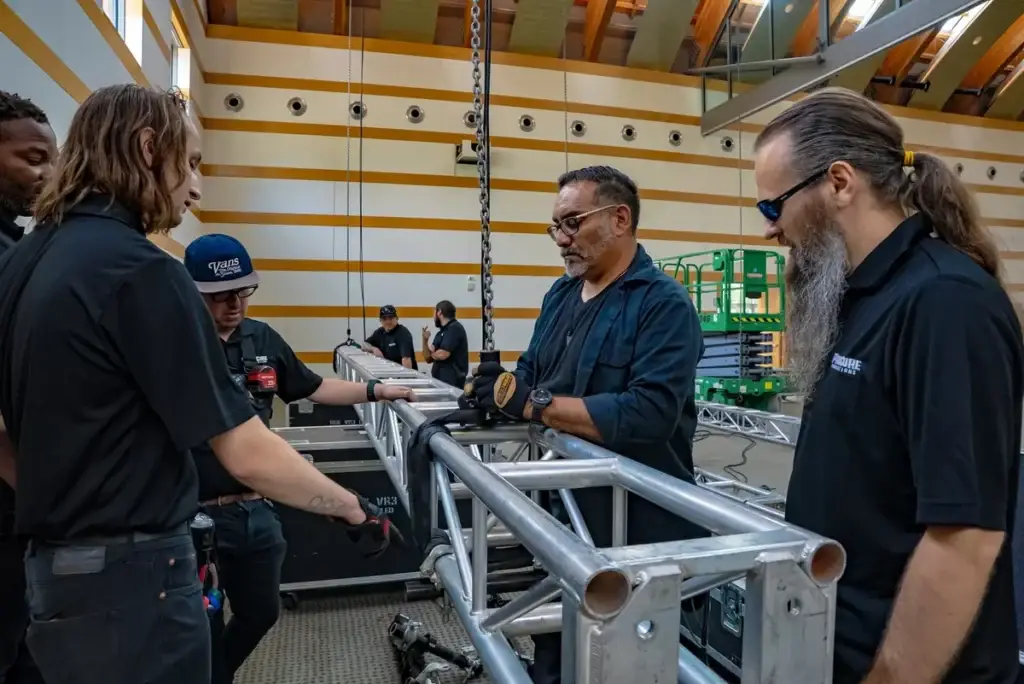
- Mounting. Truss-rigged, ground-stacked on a tower, or tabled. Each is a different labor footprint.
- Signal path. Source device, scaler/switcher, cable runs, redundancy if any. A keynote with no backup signal path is a quote that hasn’t been finished.
- Crew. A working corporate projector setup needs a tech to focus, align, and stand by during the show. Quotes that skip on-show crew are quotes that send you a remote and a phone number.
- Permit and rigging language for outdoor work. Anything hung overhead on an outdoor stage in LA needs a structural plan. A quote that doesn’t address it is one that hasn’t priced it.
The cheap quotes win the bid by leaving items out. The clean quotes win the show by including them. You aren’t comparing the same product across quotes. You’re comparing one company’s plan to another company’s optimism.