The LED wall went black at minute 19 of the keynote. Two months of pre-production, 14 hours of setup, a $42,000 invoice, and the ballroom was suddenly lit by emergency exits and 800 phone screens. The CEO kept talking. Nobody in the front row knew the difference. Everybody in row 30 did.
The cause was a 20-amp circuit pulling 22 amps because somebody at the hotel had plugged three coffee makers into the same panel as our wall during the morning catering setup. We’d specced the load. We’d asked for dedicated circuits. We’d been told yes. The hotel just had a different definition of “dedicated” than the National Electrical Code does.
This is the conversation about power, cabling, and rigging that has to happen before the wall ever ships. Most planners never have it. The ones who do, get walls that stay lit through coffee service.
The number that drives every other number
Every LED panel pulls power. The math starts there, and unfortunately it doesn’t end there.
For modern 500x500mm LED panels at full white brightness, count on roughly 600 watts per square meter for a 2.9 pixel pitch tile. That’s the number any production company should hand you in the first conversation, no calculator required. Half-brightness video content (most corporate keynote graphics) draws maybe 60 percent of that, but you spec for the worst case, not the average, because the worst case happens at minute 19 when the brand-color background loads.
A 4 meter by 2 meter wall (about 13′ wide by 6.5′ tall) is 8 square meters at 600W = 4,800 watts. That’s two 20-amp 120V circuits running near capacity. Add the processor, scaler, and signal distribution, and you’re at three circuits before you’ve turned on a single confidence monitor or a single phone charger at the FOH table.
Where it goes sideways:
- Hotel ballroom 20-amp circuits are usually shared. With other rooms (especially in older hotels). With HVAC. With the coffee station. “Dedicated” on a venue’s spec sheet can mean “not currently being used,” which is not the same thing.
- Standard cable drops in a hotel are 50 feet of 12 AWG. Past that, voltage drop matters. A 100-foot run at 20 amps will lose enough voltage to brown out the panel, which the panel will report by going slightly green for a second and then deciding to reboot.
- Power needs to be “clean.” LED processors are sensitive to dirty power (sag, spikes, harmonic distortion). Sharing a circuit with a coffee maker that cycles on and off can cause panel artifacts that the planner will spend 20 minutes telling the AV crew about, and that will mysteriously vanish when the coffee maker runs out of water.
If a vendor quotes an LED wall without specifying the circuit count, amperage per circuit, and dedication requirement, the quote is incomplete. You’re paying for a wall that may or may not stay on, depending on what catering decides to plug in.

The conversation to have with your venue (and the one they don’t want to have)
Before signal cables show up, the venue conversation has to happen. The questions almost no planner asks:
- How many dedicated 20-amp 120V circuits can you provide on the load-in side of the room? Not “available outlets.” Dedicated breakers, with breaker numbers if possible.
- Is there a 240V or 208V three-phase tap available? A wall over 6kW is much cleaner on a single 50-amp 240V drop than on three or four 120V circuits. Per NEC 525.10, portable structures over a certain amperage need a single point of connection anyway, so the venue might as well have one.
- What’s the panel location? Distance from panel to wall location matters because cable run length changes voltage drop math. A 200-foot run from a remote breaker panel needs heavier gauge cable than a 30-foot run, and “we’ll just daisy chain extension cords” is not an acceptable answer (also, illegal under NEC 525.21, but who’s counting).
- What’s running on the same panel? Other ballrooms, HVAC compressors, kitchen equipment, the coffee station? If yes, ask for circuits on a different panel.
- Can the production company add a power distro? A power distro (a small distribution box) takes one heavy feed and breaks it out into multiple 20-amp circuits, each with its own breaker. Cleaner, more reliable, code-compliant. Some venues prohibit it for “safety” reasons that are usually really commission reasons (their preferred vendor wants the labor charge, the safety story is just the wrapper).
The venue answer to question 5 is the tell on the venue. A venue that runs a clean operation is happy to coordinate with outside production. A venue that protects its in-house AV revenue will stall you.
If the venue’s answer to “we need 60 amps of dedicated power” is “talk to our AV provider,” that’s a commission conversation in a safety costume.
When the answer is a generator
Some events don’t have venue power. Outdoor activations, parking lots, parks, warehouse pop-ups, the rooftop where they swore there was 200-amp service and there’s actually a single 15-amp drop for the elevator emergency call. Then the wall lives on a generator.
Generators that work for LED walls:
- 20kW+ silent diesel is the workhorse for most corporate event LED walls. Quiet, clean output, three-phase. Runs about $400 to $800+ per day in LA depending on whether the production company owns it or rents it.
- 15kW gasoline portables are not quiet enough for keynote audio. They show up on the open mic as a low droning hum that the speaker is going to ask you about during sound check. Skip them.
- Smaller event tower units (3kW to 7kW) run a single small wall but have no headroom for additional gear. They trip when audio amps draw transient peaks, which is approximately every time the bass kicks.
The gotcha: generator output is rated at “prime” power, not surge. A 20kW prime-rated generator can handle maybe 18kW continuously. Spec your wall and gear at 70 percent of generator capacity, not 100. The day a video plays a high-brightness scene at the same time the audio amp pulls a peak, the generator drops off, and your audience experiences a brief moment of silence and darkness that will live forever in the recap reel.
If you’re in California, generator emissions regulations now require Tier 4 Final compliance for many corporate events under the California Air Resources Board’s Portable Equipment Registration Program (PERP). Tier 4 is the cleanest current standard. Older Tier 2 and Tier 3 generators can sometimes run with a limited-hour exemption permit, but the paperwork takes weeks and CARB does check at large public events. Your production company should know this. If they don’t, ask which engineer in Sacramento they’ve talked to recently.
Cabling: where signal dies between the rack and the wall
Power gets the wall lit. Signal gets the content on the wall. Two different problems, both with their own ways to make minute 19 of the keynote interesting.
The signal chain for an LED wall looks like this:
- Source (laptop, video server, camera switcher)
- Scaler/processor (resizes signal to wall resolution)
- Sender card (converts to wall protocol, usually CAT5 or fiber)
- Distribution from sender to first cabinet
- Daisy chain from cabinet to cabinet through the wall
- Cable looped back to processor for redundancy (very important)
The fragile points:
- CAT5 runs over 100 feet need fiber. Most production teams use fiber (more reliable, longer runs, immune to RF interference from the lighting truss six feet away). If the quote shows CAT5 from FOH to wall and the room is more than 100 feet, ask why. The honest answer is “we own a lot of CAT5.” That’s not your problem to solve.
- Daisy chain limits. Most LED panels can chain 8 to 12 cabinets per CAT5 run before signal degrades. A 24-cabinet wall needs at least three sender outputs. Vendors who try to chain 16 cabinets on one run are gambling with your event budget, and don’t understand the limits of their processor.
- Connector quality matters. A cheap RJ45 connector at minute 18 of a keynote will drop. We use shielded etherCON connectors specifically because the open RJ45 is the most common on-site failure point we see. The clip breaks, the cable wiggles, the signal drops, and somebody learns about etherCON the expensive way.
- Signal redundancy. Real production walls have a redundant sender. If the primary fails, the backup picks up automatically. Most cheap quotes don’t include this. The quote that costs $1,200 less than the next quote? It probably skipped the redundant sender. The math becomes obvious when the primary sender fails and the wall is dark for two minutes while a tech swaps cables under stage right.
Cable should be flat (taped to the floor with gaff tape and cable yellow jackets) or hung overhead, never coiled across walking paths. You don’t want to see an LED wall go down because somebody from catering tripped on a CAT5 run during the dinner break. Your AV partner should run all signal cable through cable ramps even when the venue says it isn’t necessary.
Rigging: the part that holds the wall up (in theory)
A 4m x 2m wall weighs roughly 640 pounds (80 pounds per square meter is a working number). That weight has to live somewhere, and “live somewhere” is the entire job description of rigging.
Three rigging modes:
- Ground stack. Wall sits on a platform riser or directly on the floor with outrigger arms for stability. Easiest, cheapest. Limited height (typically 12 feet max because the stack starts to lean once you go higher and the outriggers stop being able to fight gravity). Needs ballast (sandbags, water barrels, or weighted feet) at the outriggers.
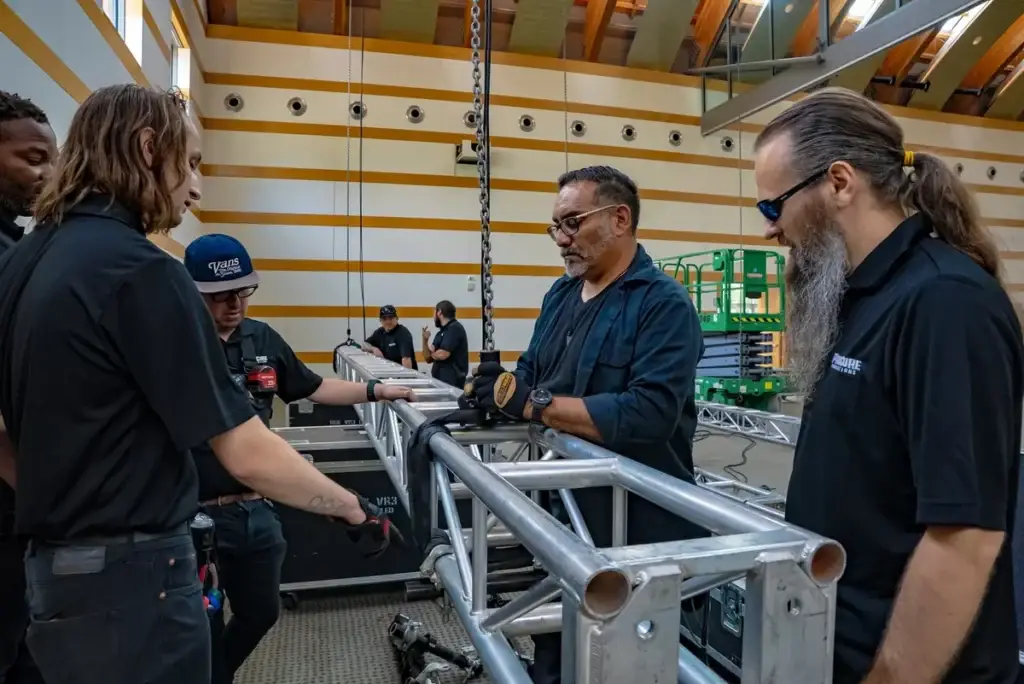
- Truss-supported. Wall hangs from a horizontal truss bar that’s either floor-supported on towers or hung from venue rigging points. Allows higher placement, cleaner sightlines, no ballast clutter at the base. Adds cost (truss rental, hardware, often a structural engineer review under ANSI E1.21-2024, the entertainment industry standard for outdoor temporary structures, which is now referenced by both the 2024 International Building Code and Fire Code).
- Flown. Wall hangs from venue rigging points (chain motors, beams, structural attachments). Most common in convention centers and theaters that have a grid. Cleanest look, also the most expensive and the longest install time. Also the most paperwork-intensive, because you’re now hanging 640 pounds of glass-and-metal over an audience.
The math people miss:
- Outrigger count. Ground-stack walls need outriggers every ~1 meters along the base. A 4m wall needs 5 outriggers minimum. Vendors who skip an outrigger to “save floor space” are saving floor space the way removing a smoke detector saves ceiling space.
- Ladder/stack height. Each outrigger needs a ladder/post height that matches wall height. A 3-meter-tall wall on outriggers needs (3) 1 meter ladders, plus clamps every 1 meter to lock the wall to the ladder. Fewer clamps means more sway. More sway means a wall that visibly moves when somebody walks past. The CEO will notice.
- Ballast load. A typical outrigger needs 100 to 200 pounds of ballast at its foot to keep the wall from tipping in the event of a person leaning into it. That’s 4 to 8 sandbags per outrigger, minimum. Some vendors use one or two. Those vendors are gambling.
- Permit threshold. In LA, ground-stack walls under 12 feet at indoor private venues typically don’t need a permit. Outdoor, over 12 feet, or over an audience hits the engineering conversation. ANSI E1.21-2024 is the standard the engineer is going to want stamped, so make sure your production company has somebody who actually does that.
A real production quote will include rigging specifics: ground stack vs truss, ballast count, mounting hardware, and labor for rigging vs trim/aim. A vague “rigging” line item is the line item where corners get cut, and the corners that get cut are the ones holding 640 pounds in the air.
Five questions before signing the contract
Five questions that separate a real LED wall quote from a delivery-with-extra-steps quote.
- What’s the total power load and how is it being delivered? Specific circuit count, amperage, voltage, dedication requirement, and whether the venue is providing or you’re sourcing a generator.
- Where is the signal chain? Is there a redundant sender? Backup is the difference between a brief glitch and a black wall. “It’ll be fine” is not redundancy.
- How is the wall rigged and what’s the ballast plan? “It’ll be fine” is also not a ballast plan.
- What’s the on-site failure recovery? Hot-spare panels in the truck? Backup processor? Named tech who can swap a cabinet during a show without stopping the keynote?
- Who pulls the permits if needed? Outdoor or over-12-foot walls don’t move without paperwork. Don’t be the planner who finds out at load-in that nobody filed.
If the answers are vague, the quote is vague. Vague quotes turn into change orders, and change orders are paid by you.
Frequently Asked Questions
How many circuits does an LED wall need?
A 4m x 2m wall needs about 5,000 watts, or two to three 20-amp 120V circuits, plus one for the processor and signal gear. Larger walls scale linearly: 600 watts per square meter. Always provision for full-brightness peak, not average load. Then add a buffer because the catering team will plug something in.
Can I run an LED wall on regular venue power?
Sometimes. Hotels and convention centers usually have enough panel capacity, but you need dedicated circuits, not shared. Outdoor or off-grid events need a generator. Smaller walls (under 4 square meters) can sometimes share a panel; larger walls almost always need their own panel, and possibly their own electrician at load-in.
What kind of cabling does an LED wall use?
CAT5 or CAT6 ethernet for short signal runs (under 100 feet) and fiber for long runs. Power cables are typically 12 AWG for 20-amp circuits, heavier gauge for 30-amp or 50-amp drops. Per NEC Article 525, all temporary cable runs at events need GFCI protection, mechanical protection where they cross walking paths, and proper bonding between equipment.
Is rigging always required for LED walls?
For ground-stack walls under 12 feet, no overhead rigging is needed but ballast and outriggers are. Walls hung from truss or flown from venue points need engineered rigging plans, often with a structural review under ANSI E1.21-2024. A real production company will tell you which mode fits your venue.
What if my venue won’t let an outside production company run their own power?
Most LA hotels allow it with a COI and proper protection (cable ramps, drip pans, GFCI on every drop). If a venue blocks outside power, ask why. Often the answer is “you have to use our preferred AV vendor,” which is a commission conversation, not a safety one. Real safety concerns are negotiable. Commission requirements are fixed.
The bottom line
LED walls fail at three places: power, signal, and rigging. The expensive walls win because the production company budgets for failure recovery in each layer. The cheap walls win because the vendor cut one or more of those layers and hopes you don’t notice until minute 19, and then hopes you blame catering.
If you’ve got a wall on a quote and you’re not sure whether the production work is real, send the quote. We’ll tell you what’s there, what’s missing, and what it’ll cost you when one of the missing parts catches up at load-in.