Three AV companies bid the same event. Quote A is $8,200. Quote B is $14,800. Quote C is $22,400. Same room, same audience, same agenda. The planner reads through, can’t tell what’s different, and asks the obvious question: “Why does this cost three times more?”
The honest answer is that the three quotes are not for the same event. They look like they are. They aren’t. Treat all three as identical and you’ll buy the wrong one. Here’s what’s actually different.
Why AV quotes for the “same” event vary so much
Six things move the price by hundreds or thousands of dollars without changing what the room looks like to attendees. Most quotes hide them.
1. Equipment tier inside the same category.
“PA system” can mean a Bose L1 Compact at $200 a day or a Meyer LEOPARD line array at $4,500 a day. “Wireless mics” can mean low-tier Shure SM58 wireless at $80 each or Shure Axient Digital channels at $400 each. Same line item. Twentyfold cost difference.
2. Crew count and role specificity.
A “tech” can be a freelancer with one weekend of training or a union A1 with twenty years of broadcast experience. The cheap quote often shows two crew. The expensive quote shows six, named by role: A1 (audio engineer), A2 (audio assistant), V1 (video engineer), L1 (lighting), and a producer running show calls. Both quotes claim to “run the event.” One actually can.
3. Day count for the same show.
A “one-day event” is rarely a one-day rental. Most are 2 to 4 billable days once load-in, prep, and strike are counted.
4. Backup gear and redundancy.
A real quote includes a backup wireless channel for every primary channel, a spare LED panels, a redundant computer for show playback, and a UPS on the audio mixer. A cheap quote skips all of it. The savings show on paper. The cost shows when a transmitter fails at minute 12 of the keynote.
5. Pre-production hours.
Show prep happens weeks before the event. RF coordination for wireless mics. Content prep and color matching for video. Power load calculations. Site survey. Real quotes itemize these as “pre-production engineering” with hours and rates. Cheap quotes assume the show will work itself out.
6. Venue logistics.
Parking, dock master fees, freight elevator operator, union venue labor minimums, mandatory house electrician. A vendor that’s worked your venue knows these numbers and includes them. A vendor pricing your show from a generic template misses them, then either eats the cost or hits you with a change order on event day.
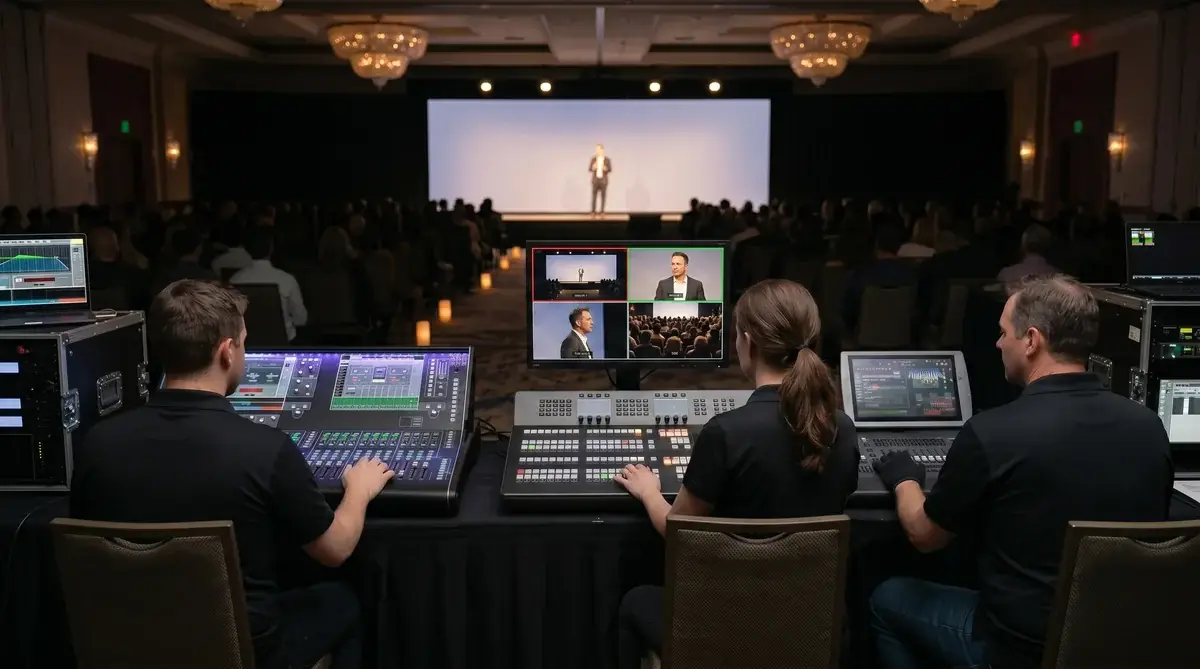
Anatomy of a 3x quote variance
A representative LA corporate keynote, 250 attendees, hotel ballroom, full-day agenda with a recorded keynote. We’ve seen this exact spread on three separate occasions. The numbers move slightly between events; the shape of the variance is identical.
Quote A: $8,400
- 1 line array system, 2 wireless mics, 1 projector and screen
- 2 techs, 8-hour show day
- 1 day rental, no separate load-in or strike line
- No backup gear listed
- No pre-production hours
Quote B: $14,800
- 1 line array, 4 wireless channels, 12 by 7 LED wall at 2.6mm pitch, basic stage wash
- 4 techs (A1, A2, V1, L1), 12-hour show day
- 2 days rental (load-in and show day combined, strike included)
- 1 backup wireless channel
- 4 hours pre-production engineering
Quote C: $22,400
- Same gear tier as Quote B, but with redundant audio (backup mixer in shadow), hot-spare LED panel, UPS on critical circuits
- 6 techs (adds backup A1 and a producer)
- 3 days rental (separate load-in, show day, and strike days)
- Full backup channel pack, redundant content laptops
- 12 hours pre-production engineering, including site survey
The audience would not see the difference between these three productions until something went wrong. In any of the dozens of small ways that AV equipment can fail mid-show, Quote C handles it without anyone noticing. Quote B handles most of them. Quote A doesn’t handle any of them.
That’s where the price difference is. It’s not the gear in the room. It’s what happens when the room throws a curveball.
How to put three quotes on equal footing
A practical checklist. Walk through this before signing anything.
Equipment
- Are model numbers listed on every line item? “PA system” is not a model number. “QSC K12.2 Mk2” is.
- Are panel counts and pitch listed for any LED walls? “20-foot LED wall” is not enough. “Absen PL2.6 Pro, 90 panels, 2.6mm pitch” is.
- Are wireless mic transmitter and receiver models listed? Frequency range, channel count, antenna distribution included?
- Are projector lumens, lens, and screen size listed? “Projection package” is not enough.
Crew
- Are crew listed by role (A1, A2, V1, L1, producer) and count?
- Are show-day hours separate from load-in and strike hours?
- Is there a named lead engineer or producer on the quote? Not just a salesperson.
- Are union or venue-required labor minimums included?
Days and times
- Are load-in, show, and strike days separately accounted for?
- Are the quoted hours actual on-site hours, or just show-window hours?
- Is overtime rate listed in case the show runs long?
Backup and redundancy
- Is there a backup channel for every primary wireless mic?
- Is there a backup mixer or A1 on standby for shows over 200 people?
- Is there a UPS on critical circuits (audio mixer, video switcher, content servers)?
- Is there a hot-spare LED panel onsite during the show?
Pre-production
- Are pre-production engineering hours listed (RF coordination, content prep, signal flow design)?
- Is a site survey included?
- Is content prep time listed with the V1 or content operator’s name?
Venue and logistics
- Are trucking, fuel, and venue parking listed as line items?
- Is dock master, freight elevator, or house electrician fee included?
- Is COI (certificate of insurance) generation handled and listed?
Contingency
- What’s the change-order policy for added items on event day? Is there a published rate?
- What’s the policy if the event runs long?
- What’s the policy if a piece of equipment fails and a replacement is needed?
If you’re missing answers on more than three of these on any quote, you don’t have a comparable apples-to-apples bid. You have an asymmetric set of three estimates with different scopes.
What to do with the three quotes once you’ve leveled them
Send the same checklist to all three vendors and ask them to refile the quote with each item answered. Two things happen.
Quote A gets bigger. The cheap vendor adds the missing items, and either the price climbs to roughly Quote B levels or they admit they weren’t including the items at all.
Quote C gets justified. The expensive vendor’s quote starts looking less expensive once you can see what’s inside it. The redundancy budget, the named crew, the pre-production hours, the strike day. Each item makes sense once it’s on paper.
The right quote is rarely the cheapest. It’s also rarely the most expensive. It’s usually the one with the most items broken out, the most specific gear listed, and the most detailed pre-production plan. Specificity is the signal.
We dig into the related red flags in our AV quote red flags post, and the broader pricing context in why the cheapest AV quote almost always costs more.
A note on “we’ll match the lowest price”
Some vendors offer to match the cheapest quote on your desk. Send them the leveled scope checklist and ask them to match that, line by line. Most won’t. The few that do are worth working with. Matching the price without matching the scope just delivers a cheap-quote version of the show with a different logo on it.
Frequently Asked Questions
Should I always go with the most detailed quote?
Not always. Detail is the signal that the vendor has thought through the show, not a guarantee they’re the right fit. The most detailed quote is the starting point for comparison. From there, talk to the lead engineer, ask for references at similar venues, and look at how they answer follow-up questions.
What’s a reasonable spread between quotes for the same event?
A 30 to 50 percent spread is normal and reflects genuine differences in tier, crew, and redundancy. A 100 to 200 percent spread (3x) almost always means the lower quotes have excluded scope. Run the checklist before assuming the high quote is overpricing.
How do I know if a vendor is padding the quote?
Padding shows up as bundled “package” items without specifics. “AV package, $9,000” is padding. “Specific gear list, named crew, hour-by-hour breakdown” is real. If you can’t see what’s inside a line item, ask. Vendors that pad won’t be able to defend the line items when pressed.
What if I don’t have time to send a follow-up to all three vendors?
Send the leveling checklist to your top two finalists. The vendor that responds with all items answered, in writing, within 48 hours, is the one that already has internal documentation. They know how to run a show. The vendor that responds vaguely or asks for a phone call to discuss is showing you what their event-day communication will look like.
The bottom line
Three quotes that vary 3x are usually three different events priced as if they were the same one. The cheap one strips scope. The expensive one adds redundancy and named crew. The middle one is the actual market rate for the work being asked for.
Run the checklist before you sign. The vendor that fills it in honestly is the one to hire.
If you’ve got three quotes on your desk and want a second opinion on what each one actually covers, send them over.