Most of the red flags on an AV quote are not in what you can see. They are in what is not there.
I build and review AV quotes every day. Hundreds a year. The quotes that cause the most problems on event day almost never look wrong at first glance. They look clean. Simple. Sometimes even cheaper than the competition. That is what makes them dangerous.
If you have ever gotten burned by an AV vendor, there is a good chance you could have caught it on the quote before you signed. Here are the five things I look for.
“Audio Package” is not a line item
The single biggest red flag on any AV quote is vague line items.
“Audio Package – $4,500.” What does that mean? Four wireless mics, a 32-channel console, front fills, stage monitors, and a dedicated engineer? Or two powered speakers on sticks and a wired podium mic?
Both of those get labeled “Audio Package.” One costs $4,500 to deliver. The other costs about $800.
When a vendor bundles everything into packages without itemizing what is inside them, you lose the ability to compare. You are not evaluating equipment anymore. You are evaluating a label. Labels are meaningless without specifics behind them.
A good AV quote breaks things down. You should see individual line items with quantities and rates. You should see specs or at least model categories. “2x 12-inch powered speakers” tells you something. “Sound System” tells you nothing.
This does not mean every quote needs 200 line items. But if an entire department of your event is a single line with a dollar amount next to it, that is a question worth asking before you sign.

Where did all the labor go?
On a properly scoped event, labor runs 25 to 40 percent of the total quote. Sometimes more on labor-heavy shows like multi-day conferences or live broadcasts.
So when a quote has $30,000 in equipment and $2,000 in labor, something is off.
Either the vendor is planning to run your event with a skeleton crew (one tech doing the job of three), or they buried labor costs inside equipment line items so you cannot see them. Both are problems.
A skeleton crew means corners get cut. Nobody is dedicated to audio, so your wireless mics get checked once at soundcheck and then ignored until something feeds back during the keynote. Nobody is running video full-time, so the IMAG switch is late on every camera cut.
Buried labor means you cannot evaluate staffing levels at all. You do not know if you are getting a dedicated audio engineer or a general tech who is also running the video switcher and keeping an eye on lighting.
The fix is simple. If you do not see a labor section with roles, hours, and rates, ask for one. Any vendor who pushes back on that is telling you something about how they operate.
No backup gear listed anywhere
This is the red flag most planners do not think to look for. And it is the one that matters most when something goes wrong.
Backup equipment. Redundancy. A spare wireless mic. A backup projector. An extra laptop in case the presenter’s machine crashes five minutes before their talk.
Events are live. Things break. Things fail. That is not a worst-case scenario, it is a Tuesday. The question is whether your vendor planned for it or whether they are going to scramble when it happens.
I look at AV quotes all the time that have zero redundancy built in. No spare microphones. No backup playback source. No failover for the main display. The quote covers exactly what is needed if everything goes perfectly. And everything never goes perfectly.
If a quote does not mention backup equipment, ask what the plan is when something fails during the show. The answer will tell you a lot about how that company runs events.
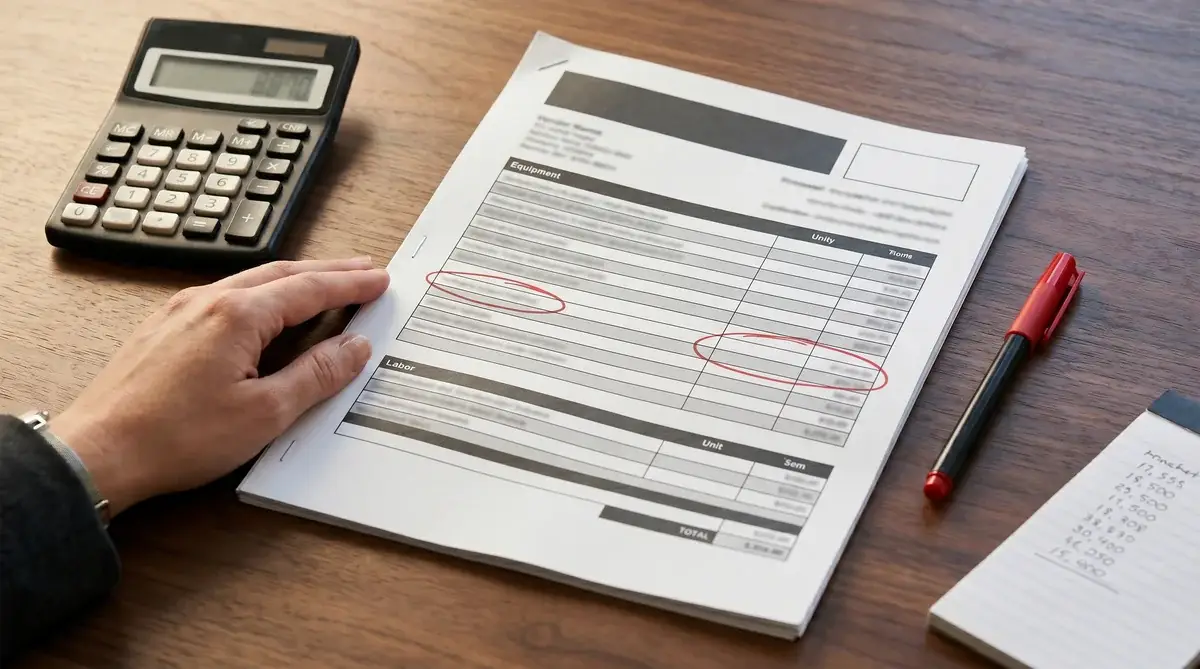
One quote is 20 percent cheaper and nobody explained why
You sent the same brief to three companies. Two came back around $25,000. The third came back at $18,000.
That is not a deal. That is a missing section.
A 20 percent gap between quotes that were built from the same event details almost always means one vendor left something out. Maybe they did not include labor. Maybe they quoted fewer crew hours. Maybe they skipped power distribution, transport, or backup equipment entirely.
Sometimes the gap is legitimate. A company that owns more inventory has lower costs. A vendor closer to the venue saves on trucking. But a significant price difference with no explanation should trigger a phone call, not a signature.
Pull the cheapest quote next to the most detailed one. Go section by section. Find what is missing. Nine times out of ten, the gap is in the line items that are not there.

No scope of work or assumptions section
This is the one that gets the most experienced planners.
A scope of work tells you what the vendor is committing to deliver. An assumptions section tells you what they assumed about your event when they built the quote. Both of these are where the boundaries live.
Without them, you have no way to know what is included and what is going to show up as a change order.
“We assumed one rehearsal day” matters when you actually need two and the crew overtime bill shows up on the final invoice. “This quote is based on ground-level load-in” matters when the venue only has a second-floor freight elevator and suddenly there is a $1,500 rigging charge.
A vendor who documents their assumptions is a vendor who has been through enough events to know where scope creep happens. A vendor who skips this section is either inexperienced or hoping you will not notice when the final invoice does not match the original quote.
The pattern behind all five
Every one of these red flags points to the same thing. The cheapest quote is almost always the most incomplete quote.
It is not that the vendor is dishonest. Sometimes they are just less thorough. They made assumptions they did not write down. They bundled things they should have broken out. They left off line items that the other vendors included.
The result is the same either way. You get a number that looks good on paper and an event that costs more than you planned.
When you are comparing AV quotes, do not start with the bottom line. Start with the structure. Does each quote have itemized equipment, a visible labor section, backup planning, a clear scope, and assumptions that match your event? If the answer is yes across the board, then compare pricing. If one quote is missing pieces, the price comparison is meaningless until those gaps are filled.
The best quote is not the cheapest one. It is the one that shows you exactly what you are getting.