An AV quote breaks into roughly seven categories: equipment rental, labor, transport, power and cabling, planning and site visits, contingency gear, and fees. A typical corporate event quote in Los Angeles has 20 to 40 line items across those categories. If your quote has five, that’s not simpler, it’s missing things you’ll pay for anyway, just later. This post decodes every line item you’re likely to see, and a few you should see but usually don’t.
Quick reference: what should be on every quote
| Category | Typical line items | Why it’s there |
|---|---|---|
| Equipment | PA system, wireless mics, projector + screen OR LED wall, stage lighting, uplights, staging, truss, pipe and drape | The gear itself, listed by model |
| Labor | Pre-production hours, load-in crew, show crew (A1, V1, L1), load-out crew, overtime | What people cost, broken down by role |
| Transport | Truck rental or company vehicle, fuel, drayage | Getting gear to and from the venue |
| Power & cabling | Distro, event power, cable ramps, UPS | Electricity and safety infrastructure |
| Planning | Site survey, CAD drawings, show file programming, rehearsal | The invisible work before the show |
| Contingency | Backup gear, spare mics, spare wireless channels | What real production companies include |
| Fees | Insurance, parking, permits, tax | The LA markup everyone forgets |
Equipment rental: what “PA system” really means
Generic line items like “PA system” or “lighting package” should always have specifics below them. Real equipment lines list the model, quantity, and day rate.
Examples of what a real quote shows:
- Line array PA (L/R stereo): 2 x 6-box hang per side, sub stack, delay speakers for back of room
- Wireless mic package: 4 x handheld, 2 x lavalier with belt packs, 1 x IEM (in-ear monitor) for presenter
- Digital console: Yamaha CL5 or DiGiCo S21, with engineer
- LED wall: 12 ft x 7 ft at 2.9mm pitch, Absen or Unilumin panels, processor, stands
If the quote says “sound system — $2,500” with nothing beneath it, that’s not detail. That’s a black box. Ask for the brand, model, and quantity behind every major line.
We covered this in more depth in how to read an AV quote and spot the red flags.
Labor: who you’re actually paying for
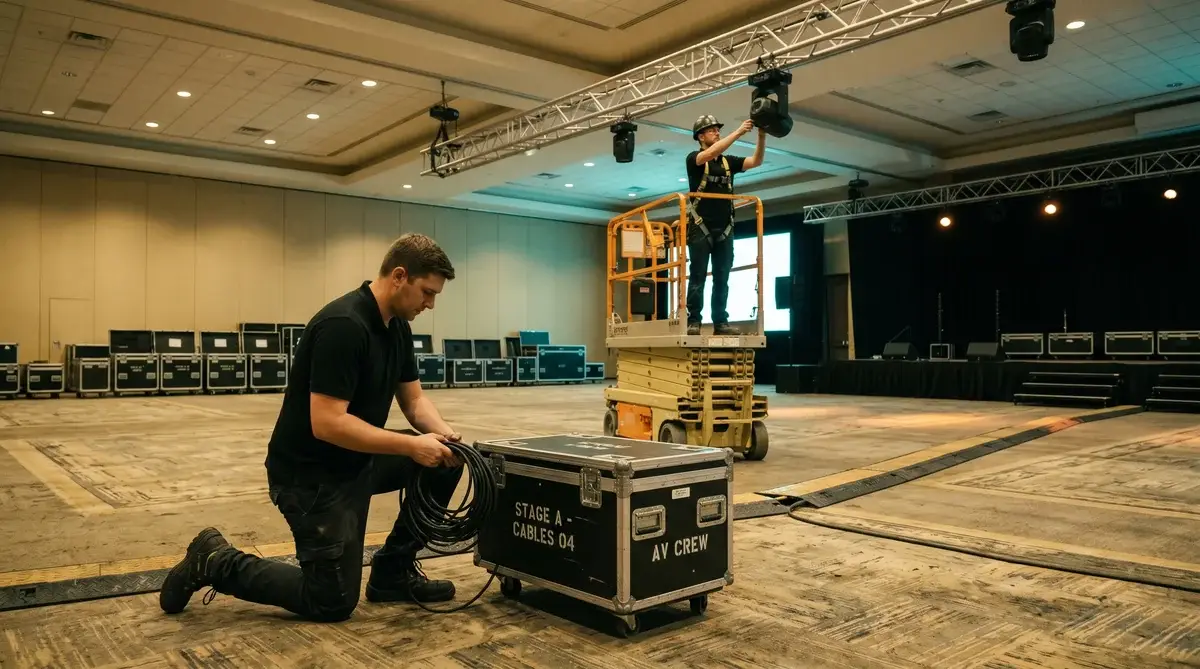
Labor is usually the most misunderstood section. Planners see “10 crew days” and assume one rate. In reality, roles have different rates because they have different skills.
A1 (audio lead / front-of-house engineer). Runs the console. Manages the soundcheck, the mix during the show, and any problems with mics or playback. Typical LA day rate: $650-900 for a 10-hour show day.
A2 (audio assistant / stage tech). Sets up mics, manages wireless packs, preps stage sound. Typical day rate: $450-650.
V1 (video lead). Runs the switcher or video control. Manages cameras, LED wall, playback. Day rate: $650-900.
V2 (video assistant). Camera operator, LED wall setup, playback queue. Day rate: $450-650.
L1 (lighting designer or programmer). Designs the lighting look, programs the console, runs the board. Day rate: $700-1,000.
Stagehand / stage tech. The hands-on crew for load-in, setup, strike. Usually on a 4-hour or 8-hour call. Day rate: $400-550.
Gaffer. Electrical and power distribution specialist. Often a single-day charge, $600-900.
Labor should also list pre-production and rehearsal hours separately from show days. These are real hours — CAD, show file programming, client calls — and they cost money. A quote that shows zero pre-production hours on a 500-person show is hiding that cost inside equipment or padding somewhere else.
Transport and drayage: the LA-specific markup
Transport is usually a single line for small shows and three or four lines for bigger ones.
- Truck and driver: Box truck or bobtail, $500-900 per day depending on size.
- Fuel: Pass-through at actual cost, typically $150-400 for LA metro, much more for out-of-market events.
- Drayage: Loading dock fees at union venues, $200-1,500 depending on the venue. LA Convention Center has specific drayage rates. Most hotel ballrooms don’t charge this, but downtown convention and LA Live properties often do.
- Parking: Day rates for crew vehicles, $40-75 per vehicle per day at most LA hotels. On a two-day show with four crew vehicles, that’s $320-600 planners often don’t expect.
If the quote has no transport line, it’s wrapped into equipment pricing. Ask.
Power and cabling: the non-gear gear
This is the stuff that makes the rest of the gear work. Real quotes itemize it because power distribution is not free.
- Event power distro: $200-600 depending on amperage and outlets. A small meeting might need a single 50-amp distro; a large show with LED walls and lighting rigs could need three or four.
- Cable ramps: For running power and signal across walking paths. $50-100 per ramp, $200-500 total for most events.
- UPS (uninterruptible power supply): Battery backup for critical gear like the mixer and wireless mic receivers. $150-300 per unit. Not optional for serious shows.
- Cabling and adapters: XLR, Cat6, HDMI, SDI, power cables. Often bundled but sometimes itemized. Expect $200-600 for a typical event.
Planning, site visits, and show file programming
The invisible work. Every good AV quote has this section. Every bad quote buries it in padding or pretends it’s free.
- Site survey / walk-through: 2-4 hours on site before the event. $300-600.
- CAD drawings: Scale diagrams of stage layout, rigging plot, signal flow. $400-1,200 depending on complexity.
- Show file programming: The video switcher file, lighting cues, audio scenes. $500-1,500 depending on complexity.
- Rehearsal: The crew is there, the gear is set, you’re running through the show the day before. Half-day or full-day crew + gear rental. $1,500-5,000.
If you don’t see any of these lines, ask how your production company is preparing for your event. If the answer is “we’ll figure it out day-of,” that’s a red flag. Good production isn’t improvised.
Contingency: what real production companies include
Backup gear is a line item that distinguishes a production company from a rental house.
- Backup wireless mics: Extra handhelds and belt packs, pre-tuned to clean frequencies. Usually 1-2 per channel.
- Spare projector bulb / backup projector: For critical visual shows. $200-600.
- Backup LED tile: Modular panels have hot-swap capability. Having a spare in the case costs almost nothing in the rental but saves the show if one dies.
- Crew contingency hour: A small padding on labor for the inevitable “one more thing” at load-out.
If contingency is zero on your quote, your provider is assuming nothing will go wrong. That’s a bet, not a plan. We wrote more about this in wireless microphone problems at events.
Fees: the LA markup everyone forgets
This is where quotes start to diverge from each other. Not every vendor itemizes these, and comparing quotes without these lines often means comparing different things.
- Insurance / COI: Certificate of insurance for the venue. Sometimes a flat $50-100 admin fee, sometimes rolled in.
- Parking pass-through: Your AV crew’s venue parking costs, recharged at cost.
- Permits: Required for outdoor events, rooftop staging, or street load-ins. Varies wildly.
- Tax: Sales tax on equipment rental. In LA County, 9.5% as of 2026.
- Travel and per diem: Only for out-of-market events. Hotel + meals for crew, usually $125-200/crew/day.
What’s usually NOT itemized (but should be)
A few things even decent quotes skip. Ask specifically:
- Who’s running the show? The person on paper versus the person at the console. Continuity matters. Good quotes list the named show crew.
- What’s the strike timeline? If load-in is priced at 6 hours, what’s strike priced at? Strike usually takes 40-60% of load-in time. Should be a line, not a hope.
- What’s the refund or cancellation policy? Usually not on the quote itself but in the signed contract. Always read the contract language, because the quote is the friendly version.
- Event insurance pass-through. If the venue requires a $2M aggregate COI, who pays for the extra coverage? Usually the client, but it’s rarely in the quote.
Red flags to watch for
- Round numbers for everything. Real rentals have specific day rates. “$5,000 for sound” without a breakdown usually means the shop guessed.
- No labor roles named. “10 crew days” is not a line item; it’s a placeholder.
- Missing transport entirely. Either it’s wrapped into equipment (which means you can’t compare quotes), or they’re planning to bill it after.
- No contingency. Means no backup plan. Means the quote is artificially low.
- “Contact for details” on key items. The whole point of a quote is to have the details in writing.
If you’re comparing three quotes and one is $8,000 cheaper than the others, the first question to ask isn’t “why are they cheap?” It’s “what’s missing from their quote that’s present in the others?” Usually a lot.
Frequently Asked Questions
What’s a reasonable number of line items on an AV quote? For a corporate event of 150-300 pax, expect 20-40 line items. Fewer than 15 usually means lines are being bundled that shouldn’t be. More than 60 means the provider is micro-itemizing to look thorough.
Should the quote list equipment by model number? Yes. “PA system” isn’t enough. “Line array (Yamaha DZR15 L/R with DXS18XLF subs)” tells you the quality tier. Model numbers let you compare quotes apples to apples.
Is tax usually included in the quote total? Depends on the provider. Some quote pre-tax with tax as a final line; some quote total with tax absorbed into the numbers. Always ask. In LA County, sales tax on equipment rental is currently 9.5%.
What does “pre-production” actually mean on a quote? Hours spent before load-in day: CAD drawings, show file programming, client calls, site surveys, vendor coordination, gear pulls. On a significant show, pre-production is 10-30 hours of work. Should show on the quote.
Can I negotiate line items? Yes, but be specific. “Can you cut $2,000 off the total?” is weak. “Can we reduce the rehearsal from full-day to half-day?” is a real negotiation. Vendors cut what they can, but they need you to tell them what flexibility exists.
Why are labor rates so different between vendors? Union vs non-union venues, experience level, benefits, and geography. LA crew rates are generally 10-15% higher than national average. A quote with crew rates below $400/day for a skilled role is either using inexperienced labor or pulling from a 1099 pool without overhead. Ask.
The takeaway
Your AV quote should read like a parts list, not a guess. If you can’t understand what each line is paying for, either the quote is vague or you haven’t asked enough questions. Real production companies welcome the questions. Quotes that can’t withstand scrutiny are usually the quotes you want to avoid.
For a deeper quote comparison framework, see how to compare AV quotes when none of them look the same. For the budget context around these numbers, what percentage of your event budget should go to AV.